Standard PDLC Film
Private when unpowered, clearer when powered. The glass holds its private state by default and is switched toward transparent when the room needs to open up, which suits spaces that are private most of the time.
Smart Film
PDLC switchable film that changes between transparent and private modes using electrical power — for offices, conference rooms, clinics and homes across Los Angeles.
Common reasons clients reach out
The basics
Switchable film can change between transparent and private modes using electrical power. The default state and powered state depend on the selected film system: standard PDLC is typically private when unpowered and clearer when powered, while reverse configurations can operate in the opposite way.
How it looks

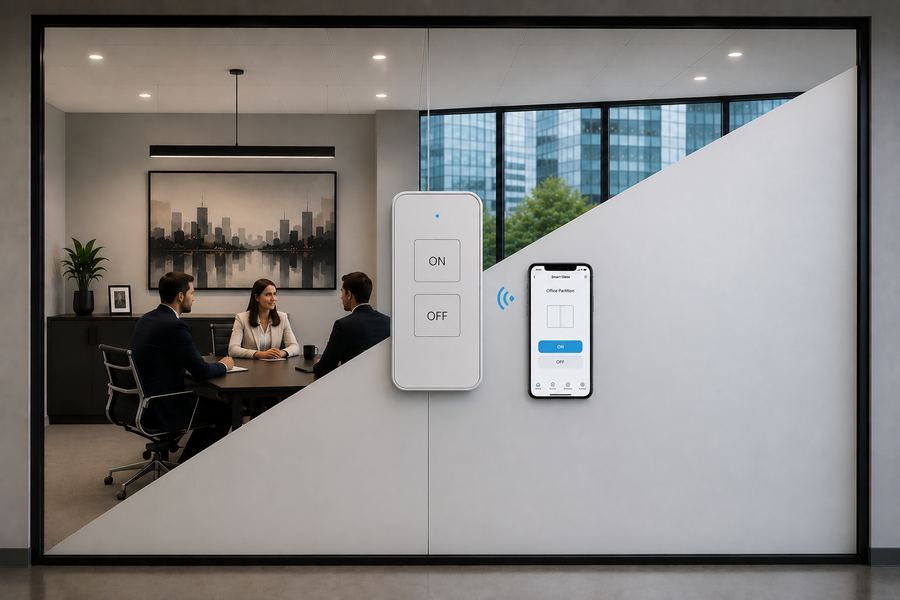
Illustrative example — final appearance depends on the selected Smart Film system, glass and lighting conditions.
Film types
Private when unpowered, clearer when powered. The glass holds its private state by default and is switched toward transparent when the room needs to open up, which suits spaces that are private most of the time.
Transparent when unpowered, private when powered. The glass stays clear by default and is switched to private on demand, which suits spaces that are open most of the day and need privacy only for part of it.
The practical question is which state the glass should hold when nothing is switched on, including what happens if power is interrupted. Neither sequence suits every project, so we confirm it for the specific system before anything is ordered.
Both change between transparent and private modes electrically, and both need a power supply and a control method at every panel. The default state is what separates them.
Choosing a film
| How the space is used | Usual system |
|---|---|
| Open most of the day, private occasionally | Reverse switchable |
| Private most of the time, opened when needed | Standard PDLC |
| Glass should stay clear if the power is off | Reverse switchable |
| Glass should stay private if the power is off | Standard PDLC |
| Bathroom, ensuite or permanently private glass | Standard PDLC |
| Not sure which state should be the default | Decided from how the room is used |
What this service solves
Interior partitions and perimeter offices that need to look open most of the time and close down for part of it. The film goes onto the partition glass, so the layout of the office does not change.
The most common request. The glass stays clear in normal use and switches to private for confidential meetings and presentations — no blinds to pull and nothing added to the design.
Consult rooms, reception glazing and interior windows that need privacy at specific moments while keeping daylight and a clean, non-clinical finish.
Bathrooms, ensuites, street-facing glass and interior glass walls in homes where fixed frosting would be permanent and blinds would not suit the space.
Power
Smart film is an electrical system, not only a film. It requires power, a transformer or power supply unit, and a control method, and that side of the project is planned before installation rather than after.
Electrical
The film has to be connected to power, and that work is planned around the building rather than around the glass. Cable routing, the position of the equipment and the switch, and who carries out the connection are all settled before installation starts.
Limitations
Smart film is more constrained than standard architectural film, and the limits are worth knowing before the design is fixed. Panel size, seams, glass compatibility and installation conditions depend on the selected smart film system and are confirmed before material is ordered.
Cost
Smart film installation starts from $60 per sq ft. Electrical work is not included. It sits in a different price bracket from standard architectural film because it is an electrical product rather than a film alone.
Setting expectations
Key benefits
Process
Share the glass or partition, rough width and height per panel, and what the space is used for. How the room is used is what decides the operating sequence.
Standard PDLC or a reverse configuration, based on which state the glass should hold by default and what should happen if power is interrupted.
Equipment locations, cable routing and the control method for the room are agreed before anything is ordered.
Electrical connection may need to be completed or coordinated with a qualified electrician, depending on the project. It is estimated separately from the film.
Smart film is made to the panel sizes for the project, so it is ordered for the job rather than taken from stock.
Panels are installed, connected and checked in both modes, and the controls are handed over with care instructions.
FAQ
Switchable film can change between transparent and private modes using electrical power. The default state and powered state depend on the selected film system: standard PDLC is typically private when unpowered and clearer when powered, while reverse configurations can operate in the opposite way. The switch itself is immediate and can be repeated as often as the room needs.
The default state. Standard PDLC is typically private when unpowered and clearer when powered, so the glass holds its private state unless it is switched. A reverse configuration works the other way — transparent when unpowered, private when powered. Neither suits every project, so which one is right depends on how the room is used and which state the glass should hold by default.
The film returns to its unpowered state, and which state that is depends on the system: standard PDLC goes to its private state, while a reverse configuration goes to its transparent state. That is one of the main reasons the operating sequence is decided before anything is ordered.
No. Private mode is translucent rather than opaque — the view through the glass is obscured while daylight still passes through. If the goal is to block light or black a room out, that is a decorative or blackout film rather than smart film.
In many cases, yes. The final recommendation depends on the glass condition, size, wiring access, controller location, and whether the project is residential, office, clinic, conference room or commercial space. Panel size, seams, glass compatibility and installation conditions depend on the selected smart film system and are confirmed before material is ordered.
No. Smart film is a privacy product — it changes what can be seen through the glass, not how much heat comes through it. Where heat and glare are the problem, solar-control film is the right answer, and the two are specified separately.
Offices and interior partitions, conference rooms, clinics and medical offices, and residential glass such as bathrooms, ensuites and interior glass walls. The common thread is glass that needs privacy for part of the time rather than all of it.
Smart film installation starts from $60 per sq ft. Electrical work is not included. The final cost depends on the panel sizes, the system selected, the number of panels, the control method and the electrical work involved, so we confirm the figure after seeing photos and sizes.
Smart film requires power, a transformer or power supply unit and a control method, so there is an electrical side to every project. Electrical connection may need to be completed or coordinated with a qualified electrician, depending on the project. We confirm what is involved once the equipment locations and cable routing are agreed.
Where we work
We install smart film throughout Los Angeles and surrounding areas for offices, conference rooms, clinics, medical offices and homes.
Next step
Send photos of the glass or partition, rough sizes per panel and your ZIP code. Tell us how the room is used and we’ll recommend an operating sequence and confirm what the power and control side involves.